 Skip to content




Replacing or upgrading a residential heating system is one of the most significant home improvement decisions a Massachusetts homeowner can make. Done well, a properly specified and installed system provides reliable, efficient comfort for 15 to 20 years. Done poorly, it leads to uneven heat, higher energy bills, and premature equipment failure.
Massachusetts homes carry specific considerations that do not apply everywhere. The climate is demanding, the housing stock is older than the national average, fuel choices vary by location, and the state’s Mass Save program offers meaningful rebates that reward planning ahead. This guide covers the practical tips Worcester County and Central Massachusetts homeowners should follow when planning a residential heating installation.
Start With a Home Energy Assessment Before Choosing a System
The most common mistake homeowners make before a heating installation is choosing the equipment first and preparing the home second. In Massachusetts, weatherization and air sealing are important first steps before upgrading other aspects of your home, such as installing heat pumps, to make sure they run efficiently. A poorly insulated or drafty home makes every heating system work harder than it should.

The Mass Save program provides no-cost home energy assessments to all Massachusetts utility customers in one-to-four unit homes. An energy specialist visits your home, reviews your current heating system and insulation levels, identifies air leakage points, and outlines which improvements are available at reduced or no cost before you invest in new equipment.
Air sealing your home and sealing and insulating ductwork ensures that there are as few gaps as possible for indoor heat to escape and cold outdoor air to get in. This reduces the overall heating load on your system. A smaller heating load means a more appropriately sized system, lower operating costs, and better comfort year-round.
Scheduling a Mass Save assessment before getting contractor quotes puts you in a much stronger position. You will understand what weatherization work qualifies for coverage, you will have a realistic picture of your home’s actual heating load, and you will be able to evaluate contractor proposals with better context.
Understand Which Heating Systems Suit Massachusetts Homes
Massachusetts homes use a wider range of heating systems than many other parts of the country. Natural gas is currently the dominant heating source in the state, though heating oil remains the second most prominent fuel, and air source heat pumps are growing rapidly due to Mass Save incentives. The right system for your home depends on your fuel access, your existing infrastructure, your budget, and your long-term goals.
Gas and Oil Furnaces
A gas furnace remains a practical choice for Massachusetts homes with access to a natural gas line. Today’s high-efficiency gas furnaces achieve minimum efficiency ratings around 90 percent, compared to only 60 to 70 percent for units built a few decades ago. For homes in Worcester and surrounding communities where natural gas is available, a high-efficiency furnace paired with a central AC system continues to be a reliable and cost-effective option.
Oil furnaces and boilers remain common in older Central Massachusetts neighborhoods where natural gas lines have not been extended. If your home relies on oil heat and you are planning a replacement, this is also a natural point to evaluate whether converting to a heat pump or hybrid system makes long-term financial sense given current Mass Save rebate programs.
Boilers and Hydronic Systems
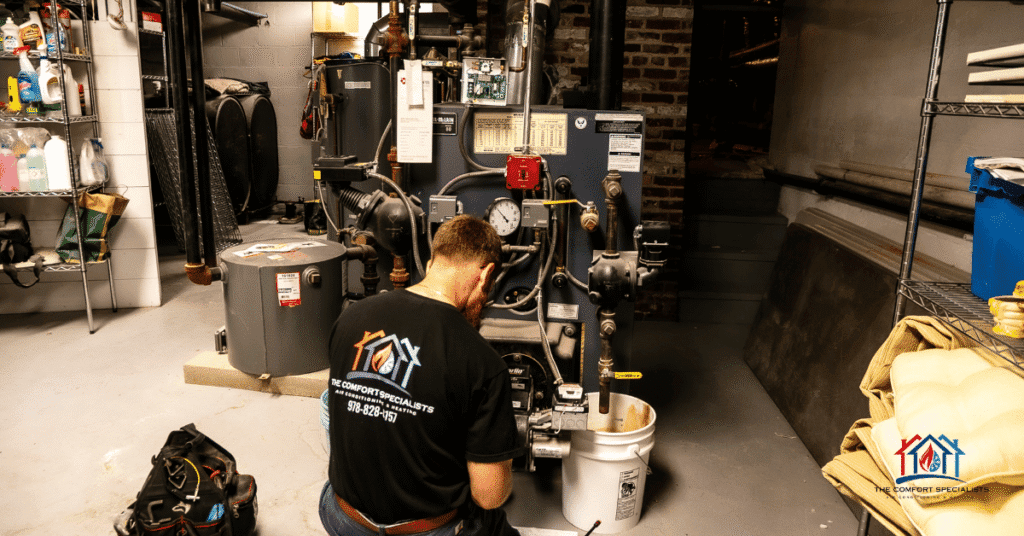
Many older Worcester County homes have boiler-based heating systems using radiators or baseboard hydronic units. Boilers are energy-efficient and durable, and since most operate on closed-loop systems, they provide steady, radiant warmth without the drafts associated with forced-air systems. Replacing a boiler requires a contractor experienced with hydronic systems, which differ meaningfully from forced-air work.
If your home has a boiler and you are planning a replacement, you can review what to consider when evaluating boiler repair and replacement options to understand when a repair makes more sense than a full swap.
Heat Pumps
Heat pumps are increasingly the right choice for many Massachusetts homes, particularly for homeowners replacing oil or electric resistance heating. Natural gas is currently the dominant heating source in Massachusetts, while an increasing number of households are installing air source heat pumps as Mass Save incentives make the transition more financially accessible.
Cold-climate heat pump models are specifically designed to perform efficiently in Massachusetts winters, and today’s cold climate heat pumps can be up to 400 percent efficient and many provide efficient heating at outdoor temperatures as low as -15°F. A single heat pump system handles both heating and cooling, which eliminates the need for separate equipment and simplifies ongoing maintenance.
For homes without existing ductwork, ductless mini split heat pumps are a practical path to high-efficiency heating and cooling without the construction cost of installing new ducts. For homes with existing ducts, a ducted heat pump can often integrate with the current air handling setup. You can explore how a heat pump works and whether the system type fits your home’s configuration.
Hybrid Systems
A hybrid setup pairs a heat pump with an existing gas or oil furnace. The heat pump handles the bulk of the load during most of the heating season, while the furnace provides backup during extreme cold. Hybrid systems bring the efficiency advantages of a heat pump alongside the heat output of a gas furnace on the coldest days, making them a sound option for homeowners who want to reduce fuel use without committing fully to an all-electric system.
Always Require a Manual J Heat Load Calculation
Proper system sizing is not optional. It is the foundation of a successful heating installation. Oversized equipment costs more, uses more energy, and can fail to properly dehumidify your home. Undersized equipment cannot keep pace with Massachusetts winters and leaves rooms consistently cold.
The industry-standard method for residential heating load calculations is called Manual J, developed by the Air Conditioning Contractors of America. Manual J is a detailed procedure that takes into account construction materials, climate, glass area, duct characteristics, and infiltration to determine your home’s precise heating and cooling needs. It accounts for insulation levels, window area and orientation, ceiling height, and local design temperatures, all of which vary considerably across Worcester County.
Many contractors still rely on simplified rules, such as sizing by square footage alone, rather than performing a genuine Manual J calculation. A well-insulated home may need 30 percent less capacity than a poorly insulated one, and south-facing windows can add significantly more load than north-facing windows of the same size. Simply replacing the old system with a unit of the same size is not a reliable approach, because older systems were frequently oversized or installed before your home’s insulation and windows were updated.
Ask any contractor you are evaluating whether they perform Manual J calculations as a standard part of every proposal. If a contractor quotes a system without measuring your home or asking about insulation and window upgrades, that is a signal to ask more questions.
Address Ductwork Before or During Installation
If your home has existing ductwork, its condition matters as much as the equipment you install. About 20 percent of the air moving through ducts is typically lost due to leaks and poorly constructed sections. Leaky ducts reduce efficiency, create uneven temperatures between rooms, and can pull unconditioned air from attics or crawlspaces into your living areas.
Proper duct sealing can reduce heating and cooling costs by as much as 15 percent. If your ductwork is aging, disconnected in sections, or running through unconditioned attic or basement spaces without insulation, addressing it during a heating installation project is far more practical than reopening walls afterward.
Mass Save covers duct sealing as part of its weatherization program, and it can be completed alongside insulation upgrades at the time of an energy assessment. The ductwork services available through The Comfort Specialists include inspection, sealing, and repair for Worcester-area homes as part of a broader heating installation or upgrade project.
Understand Massachusetts Licensing and Permitting Requirements
Massachusetts requires specific licenses for HVAC work, and permits are required for major heating system installations. A qualified HVAC contractor will make sure your system is installed correctly and safely, and will handle permitting requirements as part of the project.
When evaluating contractors, confirm that they hold a Massachusetts HVAC license and carry current liability insurance. For heat pump installations, verify that the contractor participates in the Mass Save Heat Pump Installer Network, which is a requirement to qualify for rebates. It is also recommended to get at least three estimates from different installers to help ensure you are finding the best fit for your home and budget.
Choosing a local Worcester HVAC contractor means working with a team that understands the specific licensing requirements, utility rebate programs, and housing characteristics common to Worcester County homes. Local familiarity shortens the diagnostic process and increases the likelihood that your installation is sized and configured correctly for the climate conditions you actually experience.
Take Advantage of Massachusetts Heating Incentives
Massachusetts homeowners have access to financial programs that can significantly reduce the upfront cost of a heating installation. Planning your project around these programs is one of the most effective ways to improve the return on your investment.
The Mass Save program offers rebates for qualifying heat pump installations through utilities including National Grid and Eversource, both of which serve Worcester. For whole-home air source heat pump installations, rebates are available based on the size of the system in tons, with additional bonuses available for properly sized systems and income-qualified households.
The Mass Save HEAT Loan offers 0% interest financing of up to $25,000 for qualifying energy efficiency improvements including heating system upgrades. For homeowners who want to complete insulation and air sealing work alongside the heating installation, the HEAT Loan can cover both projects in a single financing arrangement.
If your heating system is more than 10 years old, it may qualify for the upgrade programs. If your heating and cooling equipment is more than 10 years old, high-efficiency equipment can make your home more comfortable, efficient, and budget-friendly. Starting the project with a home energy assessment connects you to the full range of available programs before any equipment is purchased.

Plan the Smart Thermostat Upgrade at the Same Time
A new heating system paired with an outdated thermostat is a missed opportunity. Properly using a programmable or smart thermostat is one of the easiest ways to save energy and money in your Massachusetts home. Smart thermostats learn your schedule, allow remote control from a phone, and some models qualify for Mass Save rebates or utility incentives.
For heat pump systems, smart thermostat integration is especially valuable because it allows you to program setback temperatures strategically without triggering your backup heat source unnecessarily. Your HVAC contractor can advise on which thermostat models are compatible with your new system and which qualify for available rebates.
The Comfort Specialists offer smart thermostat installation throughout the Worcester area, and it can easily be included as part of a full heating system installation project.
Schedule Installation in the Off-Season When Possible
If your current heating system is still functional but approaching the end of its service life, planning the replacement during fall or early spring gives you practical advantages. Contractor availability is better, pricing is often more favorable, and you have time to evaluate options without the pressure of a system failure in the middle of a Worcester winter.
The best time to buy a new furnace is during late September through November, when demand is lower and contractors can give your project more attention than during peak winter emergency periods. A system installed before winter arrives gives you the full season to confirm it performs correctly without the urgency of a no-heat situation.
For a full overview of the heating services available across Worcester County and Central Massachusetts, or to schedule a consultation on your home’s heating upgrade options, The Comfort Specialists are ready to help with honest assessments and straightforward pricing.


